|
June 1, 2010 12:08:15
Posted By The Curator
|
Hello All!
Here are a few pics from our recent plaster restoration. We still have a long way to go, but it's been a great start!
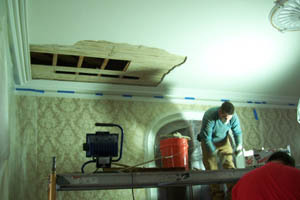
Durable Restoration of Ohio performed the work. They are known for jobs including the Warren Harding and Rutherford Hayes houses among other remarkable buildings!
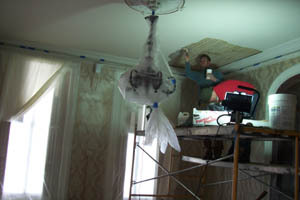
They really made our parlor looks spiffy!
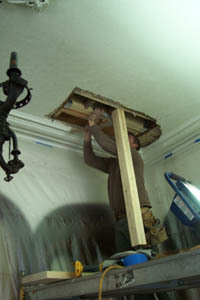
At some point mid 1900s, forced air heating was installed and a floor beam was cut through to accomodate it! They had to jack the floor up in the library and reframe the area to keep the 2nd floor on the 2nd floor!
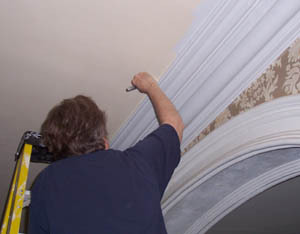
Durable was able to save samples of the removed plaster, discovering the bottom or original layer of paint! We were able to match the color using the handy computers at Sherwin Williams Paints and return our ceiling to its original color!
More photos of the completed rooms soon!!!!!!
|
|
January 3, 2010 09:23:22
Posted By The Curator
|
With the Christmas holiday over and way too many leftovers still residing in my refrigerator, I've been thinking of what has occurred over the last year and what I'd like to get accomplished in 2010. A slice of pie or two later, I have prepared a summary of what we have done at the Baldwin-Reynolds House this year for our readers as they, much like myself, have a vested interest in Henry Baldwin's historic home.
A bit of gardening
If there's one thing that I am especially excited about at the museum as of late, it is all of the hard work we have done to improve our physical landscape at the house. Several gardens on the property have been spruced up and are becoming showpieces in the area. We have several faithful volunteers working hard on keeping our gardens blooming and have had a special donation this year of over 2500 plants, both annuals and perennials, from Bollinger's Greenhouse and Florist in Springboro. These gifts have improved our garden tremendously and we are thankful to have such friends with common interests in our shared history! The work in the garden will continue over the upcoming year and we welcome any help in these efforts.
Stripping and redecorating
Our other impressive achievement this year has come in our efforts to make the Baldwin-Reynolds House appear more like a home than ever before. We have had several volunteers stripping paint off of Henry Baldwin's original tiger maple woodwork to return it to it's historic appeal. We are adding furniture, long since forgot about in storage, to the exhibits and including fine touches to make it appear as if Henry Baldwin just set a book down in his study or Katherine Reynolds just set the table for dinner. We thank you all for your donations to help in this effort including your heirlooms, assistance, and good will. We will continue to make the tour as enjoyable to you all as possible.
Outlook into the new year
As we look forward to the new year, we have much important work ahead of us to complete. We are working with an architect to restore the historic ice house on the grounds of the museum. The stone retaining wall along Lord Street needs attention that we hope to provide in the coming months, and much is about to happen in the house itself. We hope to paint several hallways, rooms, and the pine plank floors on the second floor in the near future. In addition, several plaster ceilings have issues needing addressed over the winter months. We will persevere in these activities in our effort to ensure the protection of your historic home in Meadville, Pennsylvania. After all, we are merely the guardians of our history. The keys to this history, however, remain in your hands. Your volunteer assistance and any other help is always welcome and crucial to preserving our heritage- as I am just a servant in the house...you are the master. This is my yearly report to you...enjoy the holidays and look back as well as forward. To continue progressing, we must remember.
|
Categories:
Events,
General,
Updates,
Welcome,
house,
architecture,
fun,
greek revival,
attic,
inventory,
volunteering,
Twitter,
painting,
Reynolds
|
November 17, 2009 10:30:55
Posted By The Curator
|
This week, I’ve been doing research on a building or two and decided to add another addition to our “Dating Your House” series. After spending some time in the Crawford County Courthouse this week doing some sleuthing on a building or two I’m documenting, it occurred to me (after asking for help several times…haha!) that this could be a daunting chore for those not accustomed to public records. A few weeks ago we talked about how to determine the period and architectural style of your home. What we did not cover, however, was determining who actually built your house! This long overdue article will cover just that. Ladies and gentlemen, let’s track down an owner or two, shall we?
Step One: The CountyCourthouse
Well…ok, so this is not really a step per se, but there are a few things one must remember when going to the courthouse. There are metal detectors and security guards at the courthouse doors (and with good reason), so let’s talk common sense. The easiest method of entering the courthouse and saving time doing so is to only bring what you need, thus avoiding bag checks, setting off the metal detectors, etc. Your must have list should be as follows:
- Tablet and pencils (avoid pens if possible to keep from marking records)
- Either quarters or several dollars for copies, if necessary
- Your notes (what ward or township are you in? what you already know about the building you want to research, etc.)
Avoid pockets full of miscellaneous items that are unneeded for this trip to save time.
Step Two: The Assessor’s Office
The first stop you should make in the courthouse is at the Assessor’s Office. This is where current property records are maintained for tax and value purposes. This may not be where you would think to start, but I assure you it saves steps.
First, locate your home on the maps available on the left hand wall in the back of the office based on your location in Crawford County (borough, township, city, etc.). This will give you your lot’s identification number which can then be used to pull up the card for your property in the file drawers in the center of the room. These are organized alphabetically by townships or city/borough and can be searched through rather rapidly with the lot number and location name. Your card will have your home’s value, your information (if you own this property, but even more helpful these cards often have the last several owners listed on them including who owned the property, when it was transferred, and possibly even deed book numbers to look at. You may be able to go back several decades without much effort this way. If you don’t find the card…just ask! Often new transfers or lots do not have a card immediately. Now we have this information, let’s move on to the next step!
|
Categories:
Events,
General,
Updates,
Welcome,
house,
architecture,
fun,
dating,
greek revival,
federal,
gothic,
italianate,
tudor,
attic,
volunteering,
blog,
email
|
November 17, 2009 10:29:55
Posted By The Curator
|
Step Three: Register and Recorder’s Office
This step can be the most fun and often the most time consuming! The Register/Recorder’s Office holds deeds, mortgages, agreements, etc and can be a wealth of information. Start with the information you received at the Assessor’s Office and find the earliest possible owner on this list. Then, if you have their deed information (book and page number), find that deed and check for who these people purchased it from. It may mention the last transfer in the deed (which is a great sign) including the deed book number and page. If so, keep tracking back using this method. If no “last sale” is mentioned, you must then look in the indexes. There are several sets of these spanning different date ranges. Most items from the last 30 years or so are on the computer and can be searched, however, prior to that, you much use the index and search for the last name. Most of these books have a legend at the top to help you find the correct page in the index. These records (the indexes) are arranged alphabetically by first name within being arranged alphabetically by last name. Thus, find the last name for your earliest owner and go from there. Take the book and page numbers from these to continue your search until you find various owners of your home. From here there are two places you can go.
If you run into a sheriff sale of the property (sold due to debt or unpaid taxes) you may need to cross the hall to the Prothonotary’s Office. Ask them for the records and they will refer you to their location. Otherwise, if you have the names and deeds of your home, head to The Crawford County Historical Society.
Step Four: The CrawfordCounty Historical Society
The last step in our search (other resources may be available elsewhere…other societies, the internet, and other records may be available) will often bring us to the historical society. We now have a list of names, sale dates, and prices. What do these mean? Here we will find out!
There are several resources you can use to put a life to a name at CCHS. Look in our obituary card file to see if you can find a newspaper obit for the builder or inhabitor of your house. This may tell you about their life and accomplishments. Ask the volunteer at the society to get you the city directories for your area as they may list the person and occupation. Newspapers sometimes listed new construction for each year. The History of Crawford County contains short bios of several of our earlier citizens. Check the photo card files, the marriages, and other records the staff suggest. Keep searching. Using some of these tips, you can find out who roamed the halls of your home. Who’s stories could the walls in your house tell you?
|
Categories:
Events,
General,
Updates,
Welcome,
house,
dating,
greek revival,
federal,
gothic,
italianate,
attic,
email
|
October 28, 2009 07:36:29
Posted By The Curator
|
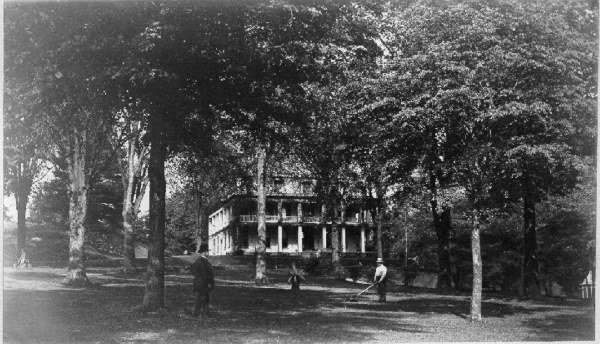
Have you ever wondered how old your house was? Who lived there? How to tell its age and style? These are all questions I get regularly at The Baldwin-Reynolds House, but usually not about the museum. Living in a house for any length of time makes one want to learn more about it, just as having a new friend or significant other makes one want to learn more about them.
We’re going to talk a little bit about “dating your house” (excuse the pun!) using details from your front porch to your living room woodwork and everything in between.
The Exterior
The Baldwin-Reynolds House Museum is a Greek Revival Mansion built in 1842-43 largely of brick. The Greek Revival style ran from about the 1820s through the 1850s. The museum is largely, in the exterior, reflective of this style with large porticos, or porches, held up by massive columns. Columns could be either round or square, making the building look very temple like. The roof of our house is not Greek Revival as the museum was originally built as a two story house with a hip roof rather than the French Mansard that was added during the 1860s renovations by William Reynolds.
After seeing the Greek Revival exterior of the house, the interior is stunningly different. William and Julia Reynolds remodeled the first floor during their more than 60 years of inhabitance and John and Katherine changed more upon their marriage in 1911. The first floor boasts black walnut woodwork everywhere as well as parquet flooring and other accessories (gasoliers, marble fireplaces, etc.). The Reynolds boasted a stylish home and the museum is largely Victorian inside as a result. The dining room is purely a product of John and Katherine, however. The fireplace from Katherine’s grandfather’s home, mixed with a simple chandelier, and rural print wallpaper give the room a Colonial Revival appearance.
The Second Floor
The second floor drastically changes from the first, holding much more of its original characteristics. Judge Baldwin’s woodwork, with the exception of the black walnut in the hall, is largely intact. The front rooms are graced with a heavy Empire style tiger maple, complete with matching fireplaces. The lighter woodwork is also a product of its time period, with the dark heavy appearance of black walnut being appreciated much more during the Victorian Era. The windows are all the original six-over-six window panes. Minus a few notable exceptions such as the black walnut staircases, it is largely 1840s Empire.
|
|
|
|

