|
October 29, 2009 09:16:55
Posted By The Curator
|
Hi All!
We're now on Twitter!
Check us out at:
http://twitter.com/baldwinreynolds
Follow us and tell us what you think!
-The Curator
|
|
October 29, 2009 08:24:47
Posted By The Curator
|
Last weekend, The Baldwin-Reynolds House Museum helped Allegheny College and the Meadville Public Library turn back time to the 1930s! Saturday we opened the library in a very different way-nearly 80 years in the past! The museum assisted with an exhibit of 1930s fashion with several dresses, taking me to the museum’s “attic” to set up the necessary artifacts. With these efforts, one may wonder just what The Baldwin-Reynolds House has in its attic. I think it’s a wonderful time to share just what we hold in our efforts to preserve Crawford County’s history.
When an artifact is donated to The Crawford County Historical Society, it passes through a committee to determine if fits within the scope of our collection. Basically, this means we don’t end up with ten pianos, etc. Their recommendations are then sent to our Board of Directors for approval. This process, although extensive, ensures we only take what we can adequately preserve for the residents of Crawford County to best serve you.
Clothing
The Crawford County Historical Society boasts an extensive collection of clothing dating from the 1810s to after World War II. Our textiles, several hundred of them, range from military uniforms to wedding dresses and everything in between. As with all collections, there are some slim areas, mostly in terms of historic men’s clothing and clothing from the early and mid 20th century, but we are proud of this expansive collection.
Military
The Museum is a repository for military items connecting to Crawford County spanning two centuries. We continue to collect items relating to our county’s citizens both in war and peace time!
Artwork
The Crawford County Historical Society is a repository for paintings and portraits of many of our county’s early residents and this collection is always growing. We welcome paintings and lithographs of early citizens of Crawford County.
Furniture
As a house museum, we obviously hold many pieces of furniture. Several more pieces are in our attic to be rotated with those on display. We occasionally change the time period, uses, etc of a room and this collection allows us to do so. We hold everything from a working loom to several sofas and are always pursuing relevant items for display.
“Other”
Finally, we have what I call “other artifacts.” These are the items that make a house a home, or barn, or garage, or greenhouse, or anything else. Historic tools, musical instruments, china, flatware, silver, jewelry, farm equipment, even carriages or vehicles fit in this category. We have two horse drawn vehicles (carriage and wagon) and even a hose cart from a local fire department. Our collection is always growing and our attic is stuffed! If you would like to get involved in helping us care for these items, call or email at 814-333-9882 or museum@baldwinreynolds.org!
|
|
October 28, 2009 07:36:29
Posted By The Curator
|
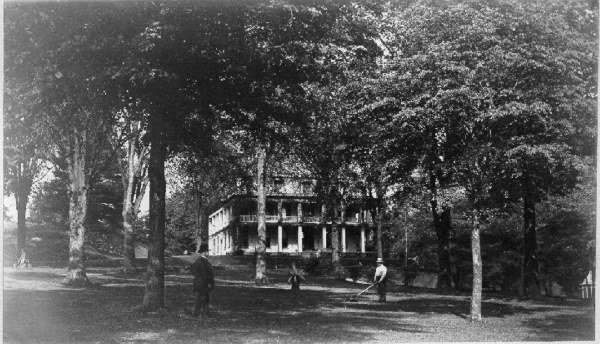
Have you ever wondered how old your house was? Who lived there? How to tell its age and style? These are all questions I get regularly at The Baldwin-Reynolds House, but usually not about the museum. Living in a house for any length of time makes one want to learn more about it, just as having a new friend or significant other makes one want to learn more about them.
We’re going to talk a little bit about “dating your house” (excuse the pun!) using details from your front porch to your living room woodwork and everything in between.
The Exterior
The Baldwin-Reynolds House Museum is a Greek Revival Mansion built in 1842-43 largely of brick. The Greek Revival style ran from about the 1820s through the 1850s. The museum is largely, in the exterior, reflective of this style with large porticos, or porches, held up by massive columns. Columns could be either round or square, making the building look very temple like. The roof of our house is not Greek Revival as the museum was originally built as a two story house with a hip roof rather than the French Mansard that was added during the 1860s renovations by William Reynolds.
After seeing the Greek Revival exterior of the house, the interior is stunningly different. William and Julia Reynolds remodeled the first floor during their more than 60 years of inhabitance and John and Katherine changed more upon their marriage in 1911. The first floor boasts black walnut woodwork everywhere as well as parquet flooring and other accessories (gasoliers, marble fireplaces, etc.). The Reynolds boasted a stylish home and the museum is largely Victorian inside as a result. The dining room is purely a product of John and Katherine, however. The fireplace from Katherine’s grandfather’s home, mixed with a simple chandelier, and rural print wallpaper give the room a Colonial Revival appearance.
The Second Floor
The second floor drastically changes from the first, holding much more of its original characteristics. Judge Baldwin’s woodwork, with the exception of the black walnut in the hall, is largely intact. The front rooms are graced with a heavy Empire style tiger maple, complete with matching fireplaces. The lighter woodwork is also a product of its time period, with the dark heavy appearance of black walnut being appreciated much more during the Victorian Era. The windows are all the original six-over-six window panes. Minus a few notable exceptions such as the black walnut staircases, it is largely 1840s Empire.
|
|
October 28, 2009 07:34:14
Posted By The Curator
|
Now we’ve seen house “dating” put into an example using The Baldwin-Reynolds House, this week we’ll go over the basic architectural styles common in our area. Before we begin, a disclaimer is in order. I am not standing in your front lawn nor am I a trained architect, but the Curator of The Baldwin-Reynolds House. These articles are primarily for the purpose of getting readers more interested in local history, and in this case the history that you are literally sleeping and cooking in every day. This week, we are focusing on styles common from Federal to Italianate (or from Meadville’s founding to roughly mid 19th century) and will get into more Victorian styles next week. If you would like more information on your house in particular, I suggest contacting the Crawford County Historical Society, who has a number of people interested in architecture and architectural history affiliated with them, or hiring an architect. On that note, onto “styling your home.”
Federal (1780s – 1840s)
The first houses in Meadville (and Crawford County) were primarily log structures as seen by the McGill House in Saegertown. These hewn log structures were often more focused on use rather than architectural detail, but as milled lumber became more common, frame structures followed and with them the Federal Style of architecture in this area.
The Federal Style is largely based on the Adams style of England. They are usually very proper in shape and design- often square, although may have oval bays on occasion. Simple doors with side lights and windows above are par for the course. These houses are the oldest buildings in Meadville.
Greek Revival (1820s – 1850s)
The Greek Revival Style has an excellent example on Terrace Street in Meadville (haha…my office!). As the nation was trying to further separate itself from Europe, Greek Revival became a “national style of sorts,” featuring classical details from Greek Architecture. Large columns, porticoes, and heave cornices highlight this style. Smaller buildings not having pillars often featured pilasters, or flat column looking features physically attached to the building rather than free standing columns. This style spread from frame houses in New England to large brick plantations in Louisiana and everywhere in between.
Gothic Revival (1840s – 1860s)
Gothic Revival architecture has its roots in Medieval buildings in Europe. These structures are literally “cathedral” or castle like with a steep roof, often board and batten siding, multiple gables, and tall narrow windows.
Italianate (1840s – 1870s)
The Italianate style contained many details suited for the warm climate in Italy. High ceilings with tall windows and flat or gently sloping roofs with overhanging cornices supported by wooden brackets were common features on these buildings. Balconies and verandas were common as well. To complete the style, cupolas or towers were often added atop these buildings. Although many Italianates were rather square or rectangular buildings, often bays, wings, and other additions to give a more picturesque effect were added.
|
|
October 28, 2009 07:13:14
Posted By The Curator
|
Now, let’s take a look at popular architectural styles common in Crawford County that are High Victorian, ending in the first half of the 20th century.
Second Empire (1860s – 1890s)
The style known as “Second Empire” takes root in France around 1860 thanks to the historical era France was undergoing with the same name. Prince Louis Napoleon became emperor of France in 1852, beginning to reshape the look of Paris buildings soon after. Much of “historic Paris” was influenced by Napoleon III (Louis Napoleon’s name as emperor).
This style is known for its most prevalent feature – the mansard roof. Steep mansards, a plethora of windows, and imposing balconies created a high society look that is typical of the Second Empire Home. Several examples of this style are seen on Terrace and Chestnut streets in Meadville.
Queen Anne (1880s – 1900s)
Queen Anne houses are, to many, the epitome of Victorian homes. These houses seem to use nearly every architectural feature imaginable and the crazier the design the better. These homes began to take hold in England in the 1870s and were soon in America.
Typical features of a Queen Anne home include: turrets, gingerbread trim, spindlework, and large wooden porches. Tinted and stained glass windows are common, sunburst and other wood pattern siding on gables are found, and the more interestingly colored houses create the better examples.
Richardsonian Romanesque (1870s – 1900s)
American architect, Henry Hobson Richardson, developed his own style combining French and Spanish Romanesque architecture using heavy stone construction in several interesting combinations of style, color, and texture. His signature building was the Trinity Church in Boston build between 1872 and 1877.
Beaux Arts and NeoClassical (1890s – 1930s)
Beaux Arts was a return to Classical style, these buildings were once again known for columns, pilasters, tooth molding along the building’s cornice, and a formality to the structure often are signatures of Beaux Arts and its middle class NeoClassical cousin.
Tudor Revival (1900s – 1940s)
Tudor Revival is based on medieval England buildings, however using much more modern materials. This style can range from cottages to mansions and nearly everything in between and is classified by steeply pitched roofs, half timber facades, and tall windows separated by mullions (wood dividers between several panes as seen with “six over six” or other patterns). This style faded by World War II, but made a return in the 1970s and is still seen today in new construction.
|
Categories:
General,
Updates,
Welcome,
Restoration,
Presentation,
house,
architecture,
fun,
dating,
greek revival,
federal,
gothic,
italianate,
second empire,
tudor
|
|
|

