|
November 17, 2009 10:30:55
Posted By The Curator
|
This week, I’ve been doing research on a building or two and decided to add another addition to our “Dating Your House” series. After spending some time in the Crawford County Courthouse this week doing some sleuthing on a building or two I’m documenting, it occurred to me (after asking for help several times…haha!) that this could be a daunting chore for those not accustomed to public records. A few weeks ago we talked about how to determine the period and architectural style of your home. What we did not cover, however, was determining who actually built your house! This long overdue article will cover just that. Ladies and gentlemen, let’s track down an owner or two, shall we?
Step One: The CountyCourthouse
Well…ok, so this is not really a step per se, but there are a few things one must remember when going to the courthouse. There are metal detectors and security guards at the courthouse doors (and with good reason), so let’s talk common sense. The easiest method of entering the courthouse and saving time doing so is to only bring what you need, thus avoiding bag checks, setting off the metal detectors, etc. Your must have list should be as follows:
- Tablet and pencils (avoid pens if possible to keep from marking records)
- Either quarters or several dollars for copies, if necessary
- Your notes (what ward or township are you in? what you already know about the building you want to research, etc.)
Avoid pockets full of miscellaneous items that are unneeded for this trip to save time.
Step Two: The Assessor’s Office
The first stop you should make in the courthouse is at the Assessor’s Office. This is where current property records are maintained for tax and value purposes. This may not be where you would think to start, but I assure you it saves steps.
First, locate your home on the maps available on the left hand wall in the back of the office based on your location in Crawford County (borough, township, city, etc.). This will give you your lot’s identification number which can then be used to pull up the card for your property in the file drawers in the center of the room. These are organized alphabetically by townships or city/borough and can be searched through rather rapidly with the lot number and location name. Your card will have your home’s value, your information (if you own this property, but even more helpful these cards often have the last several owners listed on them including who owned the property, when it was transferred, and possibly even deed book numbers to look at. You may be able to go back several decades without much effort this way. If you don’t find the card…just ask! Often new transfers or lots do not have a card immediately. Now we have this information, let’s move on to the next step!
|
Categories:
Events,
General,
Updates,
Welcome,
house,
architecture,
fun,
dating,
greek revival,
federal,
gothic,
italianate,
tudor,
attic,
volunteering,
blog,
email
|
November 17, 2009 10:29:55
Posted By The Curator
|
Step Three: Register and Recorder’s Office
This step can be the most fun and often the most time consuming! The Register/Recorder’s Office holds deeds, mortgages, agreements, etc and can be a wealth of information. Start with the information you received at the Assessor’s Office and find the earliest possible owner on this list. Then, if you have their deed information (book and page number), find that deed and check for who these people purchased it from. It may mention the last transfer in the deed (which is a great sign) including the deed book number and page. If so, keep tracking back using this method. If no “last sale” is mentioned, you must then look in the indexes. There are several sets of these spanning different date ranges. Most items from the last 30 years or so are on the computer and can be searched, however, prior to that, you much use the index and search for the last name. Most of these books have a legend at the top to help you find the correct page in the index. These records (the indexes) are arranged alphabetically by first name within being arranged alphabetically by last name. Thus, find the last name for your earliest owner and go from there. Take the book and page numbers from these to continue your search until you find various owners of your home. From here there are two places you can go.
If you run into a sheriff sale of the property (sold due to debt or unpaid taxes) you may need to cross the hall to the Prothonotary’s Office. Ask them for the records and they will refer you to their location. Otherwise, if you have the names and deeds of your home, head to The Crawford County Historical Society.
Step Four: The CrawfordCounty Historical Society
The last step in our search (other resources may be available elsewhere…other societies, the internet, and other records may be available) will often bring us to the historical society. We now have a list of names, sale dates, and prices. What do these mean? Here we will find out!
There are several resources you can use to put a life to a name at CCHS. Look in our obituary card file to see if you can find a newspaper obit for the builder or inhabitor of your house. This may tell you about their life and accomplishments. Ask the volunteer at the society to get you the city directories for your area as they may list the person and occupation. Newspapers sometimes listed new construction for each year. The History of Crawford County contains short bios of several of our earlier citizens. Check the photo card files, the marriages, and other records the staff suggest. Keep searching. Using some of these tips, you can find out who roamed the halls of your home. Who’s stories could the walls in your house tell you?
|
Categories:
Events,
General,
Updates,
Welcome,
house,
dating,
greek revival,
federal,
gothic,
italianate,
attic,
email
|
November 10, 2009 06:56:29
Posted By The Curator
|
Researching Charles Yates’ history to go along with his portrait has aroused my interest in some of the other portraits at the museum, especially the rather dignified man now hanging in my 3rd floor office. Pearson Church has fascinated much of Crawford County for generations. His legal decisions have had great impact in our history and if you spend just a minute outside the 2nd District School, you’ll see his name on a blue historical marker, outlining his achievement.
Pearson Church graduated from Allegheny College in 1856, studying law with his father, judge Gaylord Church. He was admitted to the bar in 1858 at the age of twenty. He was a husband and father of two as well as a mason and active on the Meadville School Board in the 1870s. It wasn’t until 1877, however, that his career really took off.
Church was elected President Judge of the Thirteenth Judicial District in 1877. In 1880, however, his legal abilities were put to the test when Elias Allen of Meadville put current school segregation laws to the test.
Elias Allen refused to send his son to the all black school in Meadville where the Crawford County School Board assigned him. The school was farther away from Allen’s home than the local white school and all students were educated in one room rather than by grade as in the white school. Allen sued the school board in Crawford County, claiming the 1854 state law, which stated that areas with 20 or more African American students could place them in a separate school, was unconstitutional, basing his claim on the 14th Amendment’s Equal Protection Clause. Judge Church agreed, declaring the state school segregation law unconstitutional nearly three-quarters of a century before the famous Brown vs. Board of Education decision in the U.S. Supreme Court.
Church was known for other cases as well, including the Tidewater Pipeline Case in 1883 which helped to end the Standard Oil Monopoly (in this case for carrying oil). His judicial record is one to be admired even today and this historical marker and his home still stand in Meadville as his legacy…as well as the portrait on my office wall.
|
Categories:
General,
Updates,
Welcome,
Law,
house,
fun,
attic,
inventory,
volunteering,
blog,
email,
pearson,
gaylord,
church,
segregation,
schools,
painting
|
November 4, 2009 11:02:46
Posted By The Curator
|
While doing some fall cleaning recently, I couldn’t help but become perplexed at a portrait I was walking past. Charles Yates currently resides in Section 5, Lot 121 of Greendale Cemetery (for those who would like to pay their respect) with both his first and second wife. One wonders, however, what Yates did during his lifetime? What impact did he leave? What happened during the “dash” that is now seen between the dates on his tombstone?
After having my interest sparked from this painting, I started digging (in books that is) for more information on my portrait. Charles M. Yates was born January 2, 1804 in Germantown, just outside Philadelphia, PA. He was left as an orphan at approximately eight years old, inheriting his parents’ estate. With this money for a decent education, Yates was put under the direction of a private instructor, Rev. Francis Luther. Several other schools followed, leading him to finish medical school at the University of Maryland in 1825. He practiced for over 40 years in Meadville, retiring here.
Charles Yates was married twice. He and his first wife, Maria Buchanan (brother of future President James Buchanan) were married in 1826, having five children. Maria passed away in 1849.
The November 13, 1849 issue of the Lancaster Intelligencer printed the following obituary for her:
“Died at Meadville, on Friday, the 2d instant, Mrs. Maria T. Yates, wife of Dr. Charles M. Yates, and the only surviving sister of the Hon. James Buchanan. This excellent lady throughout life endeared herself to all her acquaintances by the cheerfulness and benevolence of her disposition, and in the domestic circle she was the object of enthusiastic affection. Her last illness was long and painful; but she bore it with resignation to the will of her Heavenly Father, and died the death of a Christian. She has left a husband and six children to deplore their irreparable loss.”
In 1850 Yates was remarried to Clara Chamberlain, the daughter of a fellow doctor in Crawford County and had seven more children.
Yates was an early physician, upstanding citizen, and notable member of our community and even connects Meadville to a presidential family! What was just another “pretty face” on the walls of the Baldwin-Reynolds House now has a story. The “dash” between his dates is filled in at least a little more!
|
Categories:
Events,
General,
Updates,
Welcome,
house,
fun,
attic,
volunteering,
blog,
email,
yates,
doctor,
buchanan
|
November 1, 2009 01:12:22
Posted By The Curator
|
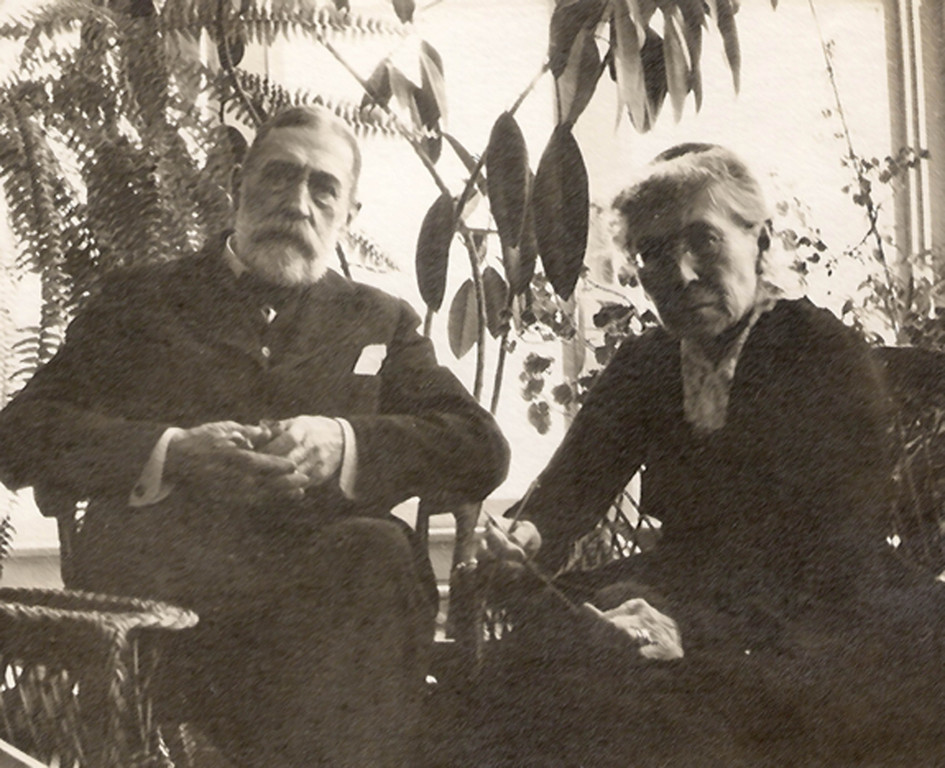
Daniel and Anna Dick Shryock- Parents of Katherine Reynolds in the BR Solarium
Now there are several ways you can keep up with happenings at the Baldwin-Reynolds House Museum in Meadville, PA! Check us out, follow us, or just leave a note to say hi!
Newspaper:
Every Monday morning you can get your fill of the BR from our article on page 2 of The Meadville Tribune! It's a great companion to coffee.
Email:
Website:
Blog:
Our blog is constantly being updated on happenings at the house and has photos of our progress...check it out by the link on our website or going to: http://apps.baldwinreynolds.org/Blog/
Facebook:
Twitter:
Granted, these are no substitutes for dropping in to say hello in person, but until we open back up in the spring...it's a great way to keep in touch!
Talk to you soon!
-The Curator
|
Categories:
Events,
General,
Updates,
Welcome,
house,
fun,
inventory,
volunteering,
Twitter,
blog,
facebook,
email
|
|
|

