|
October 30, 2009 08:22:47
Posted By The Curator
|
Hi All!
Well, the branches were gone, but today came the trunks! Check out some of these shots of Hazlett's doing their work...braver men than I am that's for sure!
Enjoy!
-The Curator
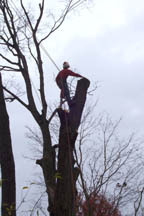
Cutting through the top of the tree...the official "tree cutter" told us it was swaying back and forth in the wind like crazy...which isn't good...because there wasn't much wind!
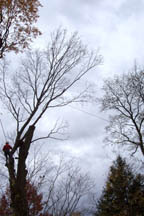
Here it comes!
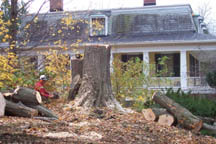
And what's left!
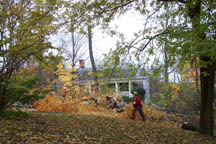
Just cleaning up the branches...thank goodness for full service!
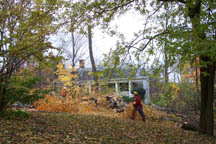
Clearing more branches
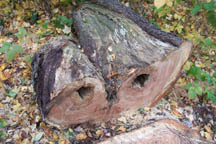
Take a look at the heartwood in the center...or more prominently the lack of heartwood! With so much rot in this tree between the heartwood and the base, it's amazing it was still standing at all!
|
|
October 29, 2009 09:16:55
Posted By The Curator
|
Hi All!
We're now on Twitter!
Check us out at:
http://twitter.com/baldwinreynolds
Follow us and tell us what you think!
-The Curator
|
|
October 29, 2009 08:24:47
Posted By The Curator
|
Last weekend, The Baldwin-Reynolds House Museum helped Allegheny College and the Meadville Public Library turn back time to the 1930s! Saturday we opened the library in a very different way-nearly 80 years in the past! The museum assisted with an exhibit of 1930s fashion with several dresses, taking me to the museum’s “attic” to set up the necessary artifacts. With these efforts, one may wonder just what The Baldwin-Reynolds House has in its attic. I think it’s a wonderful time to share just what we hold in our efforts to preserve Crawford County’s history.
When an artifact is donated to The Crawford County Historical Society, it passes through a committee to determine if fits within the scope of our collection. Basically, this means we don’t end up with ten pianos, etc. Their recommendations are then sent to our Board of Directors for approval. This process, although extensive, ensures we only take what we can adequately preserve for the residents of Crawford County to best serve you.
Clothing
The Crawford County Historical Society boasts an extensive collection of clothing dating from the 1810s to after World War II. Our textiles, several hundred of them, range from military uniforms to wedding dresses and everything in between. As with all collections, there are some slim areas, mostly in terms of historic men’s clothing and clothing from the early and mid 20th century, but we are proud of this expansive collection.
Military
The Museum is a repository for military items connecting to Crawford County spanning two centuries. We continue to collect items relating to our county’s citizens both in war and peace time!
Artwork
The Crawford County Historical Society is a repository for paintings and portraits of many of our county’s early residents and this collection is always growing. We welcome paintings and lithographs of early citizens of Crawford County.
Furniture
As a house museum, we obviously hold many pieces of furniture. Several more pieces are in our attic to be rotated with those on display. We occasionally change the time period, uses, etc of a room and this collection allows us to do so. We hold everything from a working loom to several sofas and are always pursuing relevant items for display.
“Other”
Finally, we have what I call “other artifacts.” These are the items that make a house a home, or barn, or garage, or greenhouse, or anything else. Historic tools, musical instruments, china, flatware, silver, jewelry, farm equipment, even carriages or vehicles fit in this category. We have two horse drawn vehicles (carriage and wagon) and even a hose cart from a local fire department. Our collection is always growing and our attic is stuffed! If you would like to get involved in helping us care for these items, call or email at 814-333-9882 or museum@baldwinreynolds.org!
|
|
October 28, 2009 07:13:14
Posted By The Curator
|
Now, let’s take a look at popular architectural styles common in Crawford County that are High Victorian, ending in the first half of the 20th century.
Second Empire (1860s – 1890s)
The style known as “Second Empire” takes root in France around 1860 thanks to the historical era France was undergoing with the same name. Prince Louis Napoleon became emperor of France in 1852, beginning to reshape the look of Paris buildings soon after. Much of “historic Paris” was influenced by Napoleon III (Louis Napoleon’s name as emperor).
This style is known for its most prevalent feature – the mansard roof. Steep mansards, a plethora of windows, and imposing balconies created a high society look that is typical of the Second Empire Home. Several examples of this style are seen on Terrace and Chestnut streets in Meadville.
Queen Anne (1880s – 1900s)
Queen Anne houses are, to many, the epitome of Victorian homes. These houses seem to use nearly every architectural feature imaginable and the crazier the design the better. These homes began to take hold in England in the 1870s and were soon in America.
Typical features of a Queen Anne home include: turrets, gingerbread trim, spindlework, and large wooden porches. Tinted and stained glass windows are common, sunburst and other wood pattern siding on gables are found, and the more interestingly colored houses create the better examples.
Richardsonian Romanesque (1870s – 1900s)
American architect, Henry Hobson Richardson, developed his own style combining French and Spanish Romanesque architecture using heavy stone construction in several interesting combinations of style, color, and texture. His signature building was the Trinity Church in Boston build between 1872 and 1877.
Beaux Arts and NeoClassical (1890s – 1930s)
Beaux Arts was a return to Classical style, these buildings were once again known for columns, pilasters, tooth molding along the building’s cornice, and a formality to the structure often are signatures of Beaux Arts and its middle class NeoClassical cousin.
Tudor Revival (1900s – 1940s)
Tudor Revival is based on medieval England buildings, however using much more modern materials. This style can range from cottages to mansions and nearly everything in between and is classified by steeply pitched roofs, half timber facades, and tall windows separated by mullions (wood dividers between several panes as seen with “six over six” or other patterns). This style faded by World War II, but made a return in the 1970s and is still seen today in new construction.
|
Categories:
General,
Updates,
Welcome,
Restoration,
Presentation,
house,
architecture,
fun,
dating,
greek revival,
federal,
gothic,
italianate,
second empire,
tudor
|
August 17, 2009 08:33:56
Posted By The Curator
|
With Rural Heritage Day over and the fair around the corner, summer is winding down fast. Things at the Baldwin-Reynolds House are anything but quiet this time of year. There are plenty of ways to see or get involved at the museum in the upcoming weeks, as well as throughout the fall.
Although Rural Heritage Day is over, there are still summer exhibits throughout the museum. Quilts and coverlets are prominently displayed in several rooms as well as exhibits on the Crawford County Fair and the once famous Shadeland Stock Farm near Springboro, PA. Throughout the latter half of the 1800s, the Powell Brothers raised Clydesdales of which were sold worldwide. Photos, advertising, and the Powell’s traveling trunk are just of a few of the artifacts you can still see in this exhibit.
Oil is still on the brain at The Baldwin-Reynolds House Museum as well and next on the list of demonstrations is being presented by none other than your friendly neighborhood museum curator! Keep an eye out in next week’s article for a more complete description.
The museum and the historical society will, as always, have displays at the Crawford County Fair in just another week or two. Be sure to stop in the Grange Building to see the museum’s display and the building next door to see historical society displays, books for sale, and much more!
In addition to several more programs on oil, we will have the George Delemater carriage as a float in the Oil 150 Parade! We are still looking for someone who has horses that is willing to pull our carriage through Titusville, but are looking to put it on a float if necessary.
Much more is planned as we enter fall. Be sure to keep reading for art shows, Haloween Tours, and much more! See you at the museum!
|
|
|
|

